The interplay between chirality, confinement and elasticity can drive the spontaneous formation of complex polarization patterns in chiral ferroelectric nematic liquid crystals. Researchers from the Department of Complex Matter and Condensed Matter at the Jožef Stefan Institute, together with collaborators from the University of the Basque Country and the University of Leeds, have shown how these three factors work together to transform an initially uniform state into a variety of ordered structures.
In a new study published in Advanced Materials, the researchers show that when the pitch of the material under confinement deviates from its natural pitch, periodic instabilities emerge as the material approaches a heliconical polar state. Near such transition, the bend elastic constant of the liquid crystal softens. The combination of the material’s preferred helical structure, confinement and reduced resistance to bending drives the formation of periodic polarization patterns.
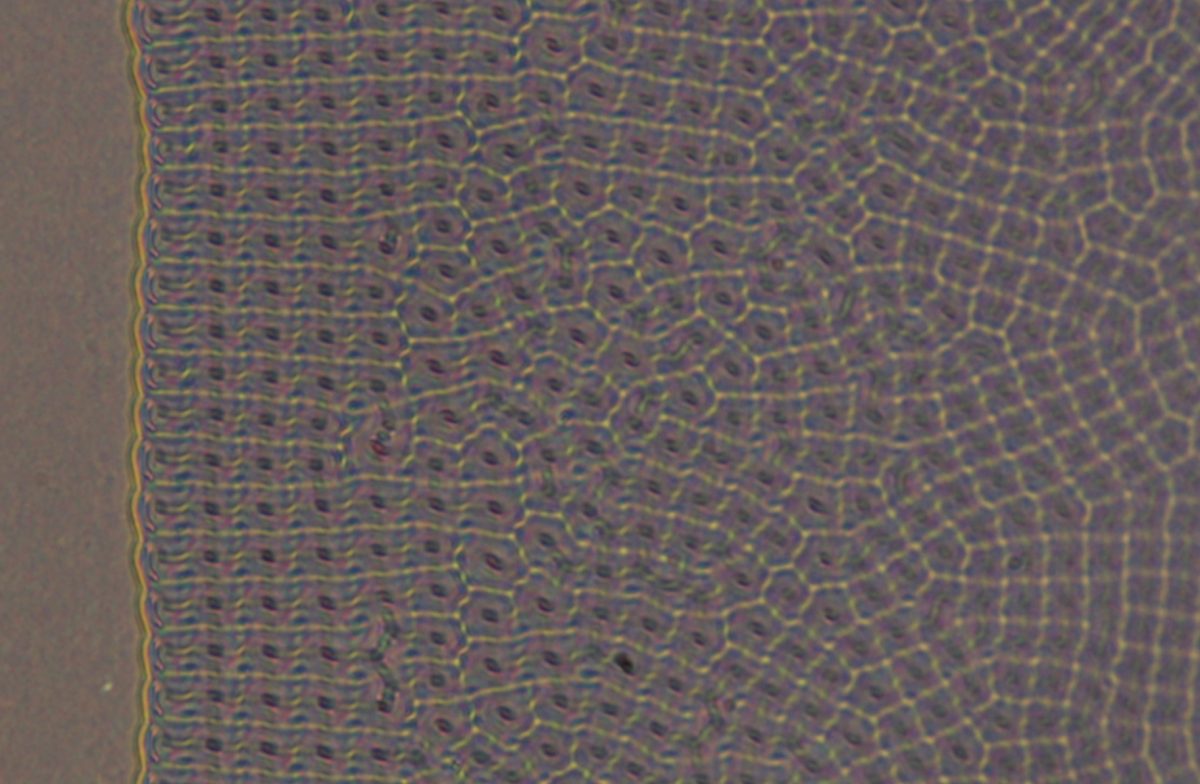
Under confinement, these instabilities give rise to a variety of self-organized structures, including stripes, squares and hexagonal patterns. By changing the thickness of the confined material and the surface alignment, the researchers can control which structures emerge. The resulting polarization patterns can also be visualized through their nonlinear optical response using second-harmonic generation imaging. The results demonstrate how chirality, elasticity and geometry can work together to organize polarization in a fluid material. They provide new insight into the physics of ferroelectric nematics and open possibilities for controlling their nonlinear optical properties and developing new self-assembled photonic structures.
Read the paper at: https://doi.org/10.1002/adma.75002