We are pleased to announce that the Jožef Stefan Institute (JSI), Department of Complex Matter (F7), will participate in the newly awarded ARTEMIS research project, aimed at developing a new generation of highly sensitive molecular quantum magnetic field sensors.
The ARTEMIS project seeks to combine the exceptional sensitivity of quantum sensing technologies with the simplicity and practicality of conventional magnetoresistive sensors (GMR and TMR). Its long-term goal is to develop a fully electrical molecular quantum magnetic field sensor capable of detecting extremely weak magnetic fields, with potential applications in medicine, security, and navigation.
The project’s key innovation is the use of paramagnetic molecules as molecular spin qubits, enabling quantum state initialization through spin-polarized electrical currents and magnetic field detection through microwave pulses and electrical readout.
The Jožef Stefan Institute will contribute its expertise in theoretical modelling, focusing on the transfer of spin angular momentum from spin-polarized electrical currents to paramagnetic molecules. This work will support the experimental development and optimization of the sensor and advance the understanding of the fundamental physical mechanisms underlying molecular quantum sensing.
The ARTEMIS project represents an important step towards more accessible, compact, and practical quantum sensing technologies.
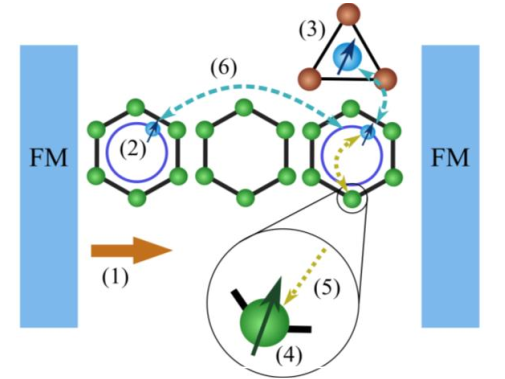
Picture:
Components of the phenomenological model. (1) charge and spin currents, (2) spinpolarized polarons, (3) paramagnetic impurities, (4) nuclear spins, (5) hyperfine interaction, (6)electron-electron exchange interaction.