JOŽEF STEFAN INSTITUTE
Department of Complex Matter
Jamova cesta 39, 1000 Ljubljana, Slovenia

Dynamics of Quantum matter

We explore non-equilibrium many-body dynamics in quantum systems that experience symmetry-breaking, topological, or jamming transitions. These systems encompass superconductors, charge-density wave, and magnetic materials.

Experimental Soft Matter Physics

The research is conducted within the “Light and Matter” research program. The interaction of light with matter is one of the most important fields of physics and optical processes are indispensable in many branches of modern industry.

For students

Are you searching for an exciting and innovative topic for your seminar, summer work, or perhaps for a Masters or Diploma research? Check available topics an start your research journey with us.

Job opportunities

We are searching for talents! If you are searching for PhD position, if you are a motivated postdoc or senior researchers, check open positions and proposed research topics.

Our partners

We strongly believe that collaboration helps provide opportunities. We collaborate with other research institutions, businesses and industry. Learn here about our associates and how to become our partner.

May 19, 2026, 15:00, MPŠ Lecture Room
Speaker: Yaroslav Gerasimenko, Department of Chemistry, University of Graz Department of Physics and Regensburg Center for Ultrafast Nanoscopy (RUN), University of Regensburg
We can increasingly drive quantum materials into new states with ultrafast light – but we still rarely watch these transformations unfold simultaneously in real time and real space, down to the atomic scale. ...
Home / News / Advanced Materials: Polar patterns in chiral ferroelectric fluids

Advanced Materials: Polar patterns in chiral ferroelectric fluids

September 24, 2026

The interplay between chirality, confinement and elasticity can drive the spontaneous formation of complex polarization patterns in chiral ferroelectric nematic liquid crystals. Researchers from the Department of Complex Matter and Condensed Matter at the Jožef Stefan Institute, together with collaborators from the University of the Basque Country and the University of Leeds, have shown how these three factors work together to transform an initially uniform state into a variety of ordered structures.

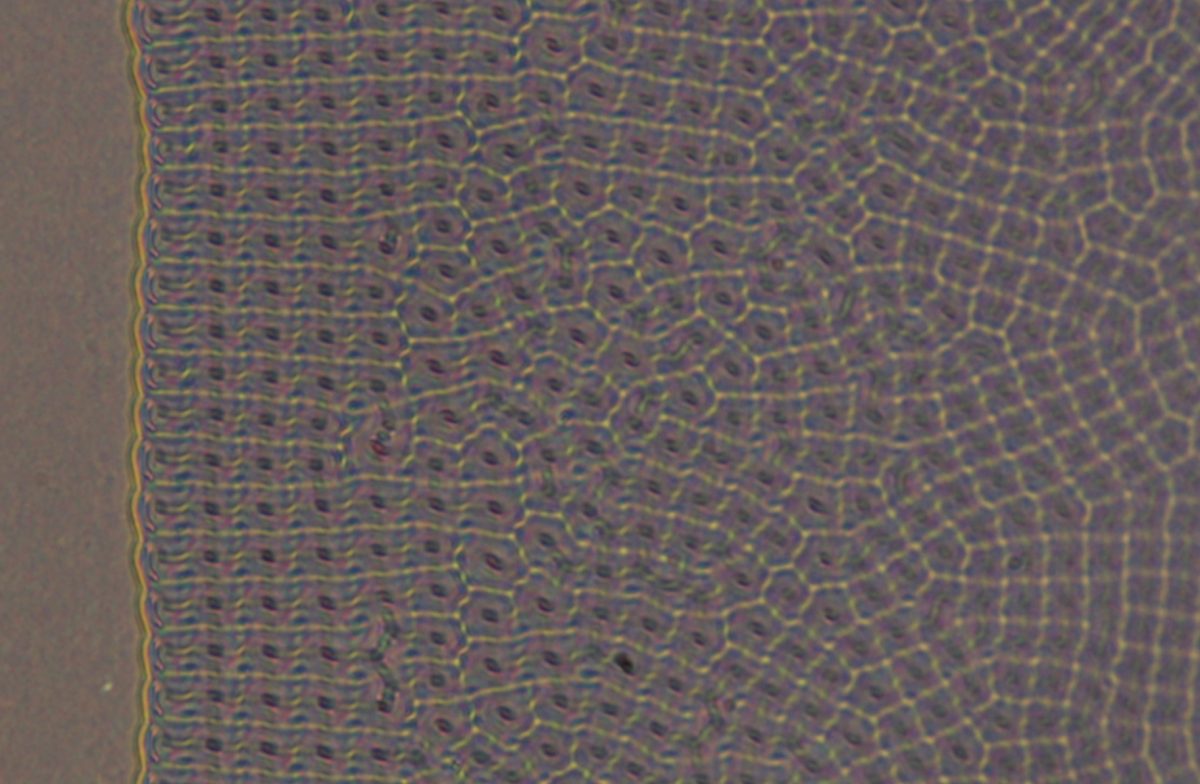
In a new study published in Advanced Materials, the researchers show that when the pitch of the material under confinement deviates from its natural pitch, periodic instabilities emerge as the material approaches a heliconical polar state. Near such transition, the bend elastic constant of the liquid crystal softens. The combination of the material’s preferred helical structure, confinement and reduced resistance to bending drives the formation of periodic polarization patterns.

Under confinement, these instabilities give rise to a variety of self-organized structures, including stripes, squares and hexagonal patterns. By changing the thickness of the confined material and the surface alignment, the researchers can control which structures emerge. The resulting polarization patterns can also be visualized through their nonlinear optical response using second-harmonic generation imaging. The results demonstrate how chirality, elasticity and geometry can work together to organize polarization in a fluid material. They provide new insight into the physics of ferroelectric nematics and open possibilities for controlling their nonlinear optical properties and developing new self-assembled photonic structures.

Read the paper at: https://doi.org/10.1002/adma.75002