JOŽEF STEFAN INSTITUTE
Department of Complex Matter
Jamova cesta 39, 1000 Ljubljana, Slovenia

Dynamics of Quantum matter

We explore non-equilibrium many-body dynamics in quantum systems that experience symmetry-breaking, topological, or jamming transitions. These systems encompass superconductors, charge-density wave, and magnetic materials.

Experimental Soft Matter Physics

The research is conducted within the “Light and Matter” research program. The interaction of light with matter is one of the most important fields of physics and optical processes are indispensable in many branches of modern industry.

For students

Are you searching for an exciting and innovative topic for your seminar, summer work, or perhaps for a Masters or Diploma research? Check available topics an start your research journey with us.

Job opportunities

We are searching for talents! If you are searching for PhD position, if you are a motivated postdoc or senior researchers, check open positions and proposed research topics.

Our partners

We strongly believe that collaboration helps provide opportunities. We collaborate with other research institutions, businesses and industry. Learn here about our associates and how to become our partner.

May 19, 2026, 15:00, MPŠ Lecture Room
Speaker: Yaroslav Gerasimenko, Department of Chemistry, University of Graz Department of Physics and Regensburg Center for Ultrafast Nanoscopy (RUN), University of Regensburg
We can increasingly drive quantum materials into new states with ultrafast light – but we still rarely watch these transformations unfold simultaneously in real time and real space, down to the atomic scale. ...
Home / News / New researsh project ARTEMIS awarded

New researsh project ARTEMIS awarded

October 23, 2026

We are pleased to announce that the Jožef Stefan Institute (JSI), Department of Complex Matter (F7), will participate in the newly awarded ARTEMIS research project, aimed at developing a new generation of highly sensitive molecular quantum magnetic field sensors.

The ARTEMIS project seeks to combine the exceptional sensitivity of quantum sensing technologies with the simplicity and practicality of conventional magnetoresistive sensors (GMR and TMR). Its long-term goal is to develop a fully electrical molecular quantum magnetic field sensor capable of detecting extremely weak magnetic fields, with potential applications in medicine, security, and navigation.

The project’s key innovation is the use of paramagnetic molecules as molecular spin qubits, enabling quantum state initialization through spin-polarized electrical currents and magnetic field detection through microwave pulses and electrical readout.

The Jožef Stefan Institute will contribute its expertise in theoretical modelling, focusing on the transfer of spin angular momentum from spin-polarized electrical currents to paramagnetic molecules. This work will support the experimental development and optimization of the sensor and advance the understanding of the fundamental physical mechanisms underlying molecular quantum sensing.

The ARTEMIS project represents an important step towards more accessible, compact, and practical quantum sensing technologies.

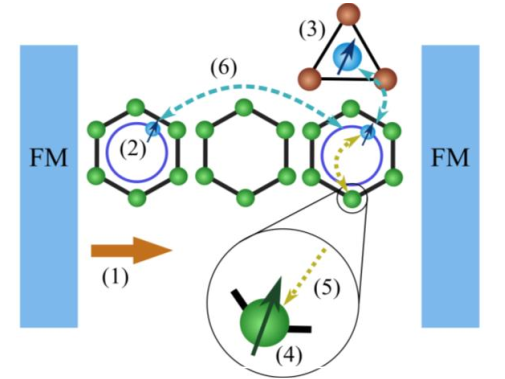
Picture:

Components of the phenomenological model. (1) charge and spin currents, (2) spinpolarized polarons, (3) paramagnetic impurities, (4) nuclear spins, (5) hyperfine interaction, (6)electron-electron exchange interaction.